The Stylesmyths: Vintage Fashion Reportage On Broadway
From vintage Playbills to politics; resistance in brocade and bourbon.
You can scroll the shelf using ← and → keys
You can scroll the shelf using ← and → keys
Porn Queens, a deluded angry actor and one vitriolic French fashion designer seems to have stolen the scene this past week with their mad, incomprehensible rants all captured on video for the world to view, replay, pontificate and dissect.
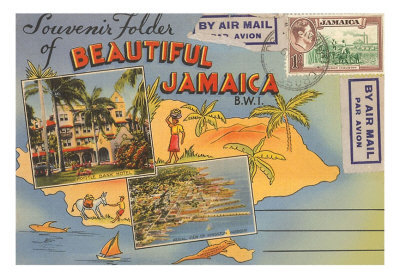
After lamenting the hobbling of the House of Dior and watching the self-immolation of a brilliant but troubled haute-couture fashion designer I yearn for respite far, far away; somewhere resort-y and tropical. A fabled destination where fluffy towels are poolside, staff is helpful & kind—bearing frozen drinks— guests are engaging, wry and humorous. After a long dreary winter for many, let’s whisk to a sanctuary where the tender breeze is jasmine-scented and a sea grape lined shore kisses a sparkling azure sea.  The Cool Customer
“When Eugenia Sheppard made the observation in her Herald Tribune column several weeks ago that she was bored with Pucci prints, the international repercussions must have been staggering. I for one can report that Jamaica’s elegant Round Hill Hotel and cottage colony, the guests who had been wearing them as a sort of school uniform were in a mild state of shock. That simple statement had automatically made half their wardrobes obsolete and deprived them of a visual passport to each other (the assumption had been that any unknown woman who appeared with a poodle or Pucci couldn’t be all bad.) But instead of throwing themselves off the side of the raft, they bravely rallied and did some strategic on-the-spot shopping—which can’t be considered a total hardship. Right at Round Hill, which John and Liz Pringle run like a small self-sustaining principality, Polly Hornberg’s Calypso Shop has a collection of island-made shorts, slacks, beach and dinner dresses, a lot of them in riotous cotton prints, that can hold their own in any resort the world over. The prices aren’t piccolini,as we say around the Uffizi, but then neither are Pucci’s.
In nearby Montego Bay, besides the smart specialty shops that cluster around the base of the leading beach-front hotels, Dorothy McNab’s waterfront emporium does a brisk over-the-counter trade and an even brisker custom order business. Her collection of silks and saris represents an investment of time and taste in addition to hard cash, and her inner sanctum boutique is geared to turning out quite sumptuous gowns, expertly fitted in three-days time. One salmon-silk dinner dress with a bodice beaded in tiny, salmon-colored seashells can be made to measure at about $150. (The beading is done in advance by the local talent.) Dorothy McNab, (sister of New York decorator, Rose Cummings, possibly the first woman to wear truly blue hair into the bright light of day) is also backing patio pajamas (which look divine on Liz Pringle as, indeed anything would) for gala evenings, and party dirndl skirts, either knee or ankle length, made of bright silk and satin patchwork at about $100. Dorothy McNab’s goodies are also available at her second shop in Ocho Rios, and a few, I hear, at Neiman-Marcus. By way of incidentals, the mad straw hats can still be had at early morning market, but I suspect even the natives are beginning to find them tiresome. And hand-culled seashells can be bought from little boys at little stands along the sea roads. The souvenir sleeper of the year, however, turns out to be Benjamin’s Eau de Cologne, a deliciously spicy scent in an un-promotional bottle, that sells at about 74 cents. I was introduced to it by Ralph Strain whose piano playing jollies up the Round Hill bar each night and whose record on Roulette label will be out any week. Jamaica’s Little Season, beginning at Easter, is now in full swing.”–Geri Trotta
____________________________________________________________________________________
The tinkling of shell beaded bodices, swish of silk saris, spicy scents perfuming the air and the elegance of patio pajamas (lost in the fashion annals of time) remind us of the essential need to relax (in style of course), unplug and take a break now and again. Even if you can’t travel to glamorous Round Hill Hotel and Villas in Montego Bay, you can click off the TV, shut out the din and cacophony, put some calypso on the turn-table and break out the blender, ice, fruit and rum. Go ahead, take that day. You deserve it!
________________________________________________________________________________________________
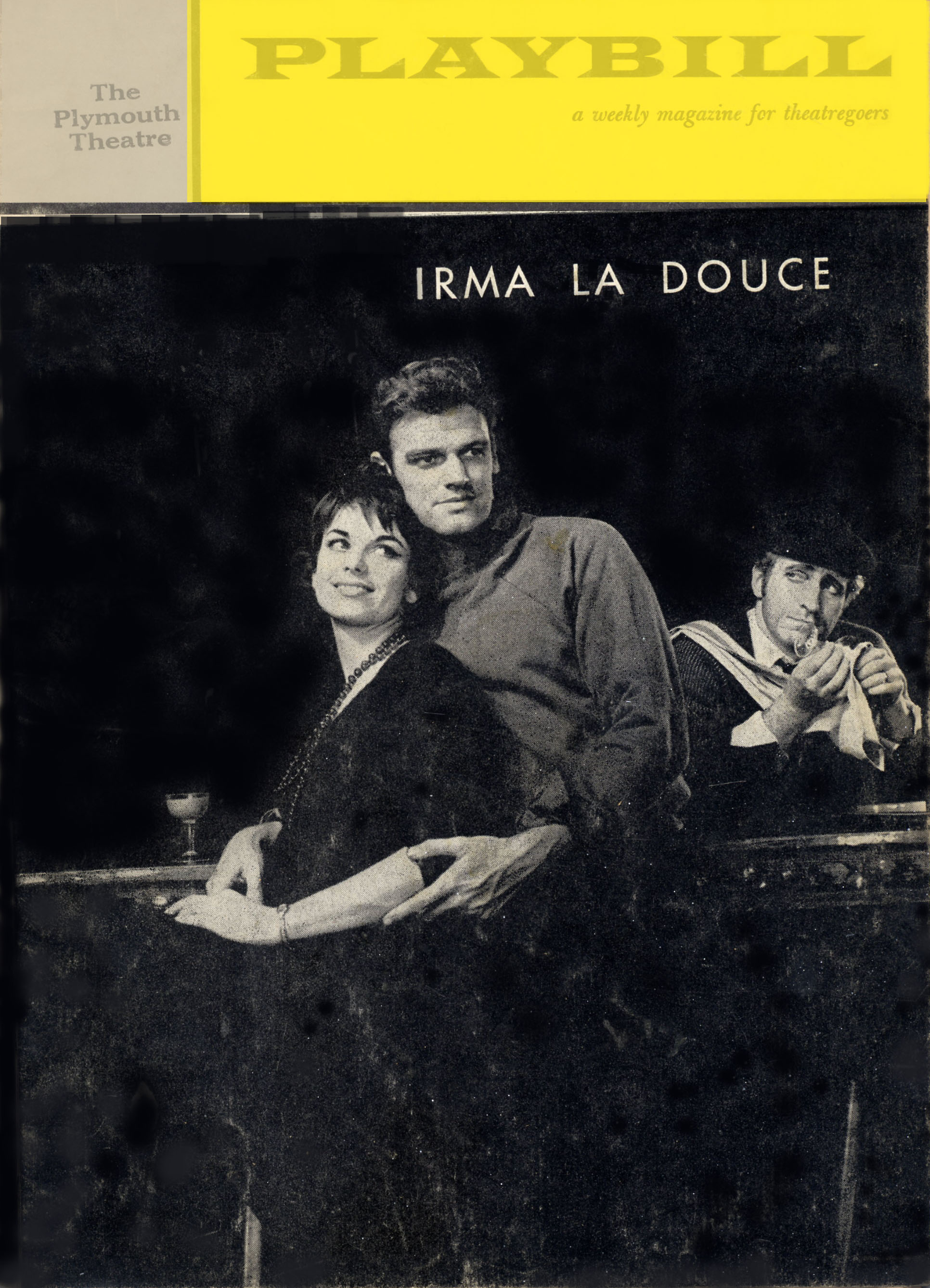
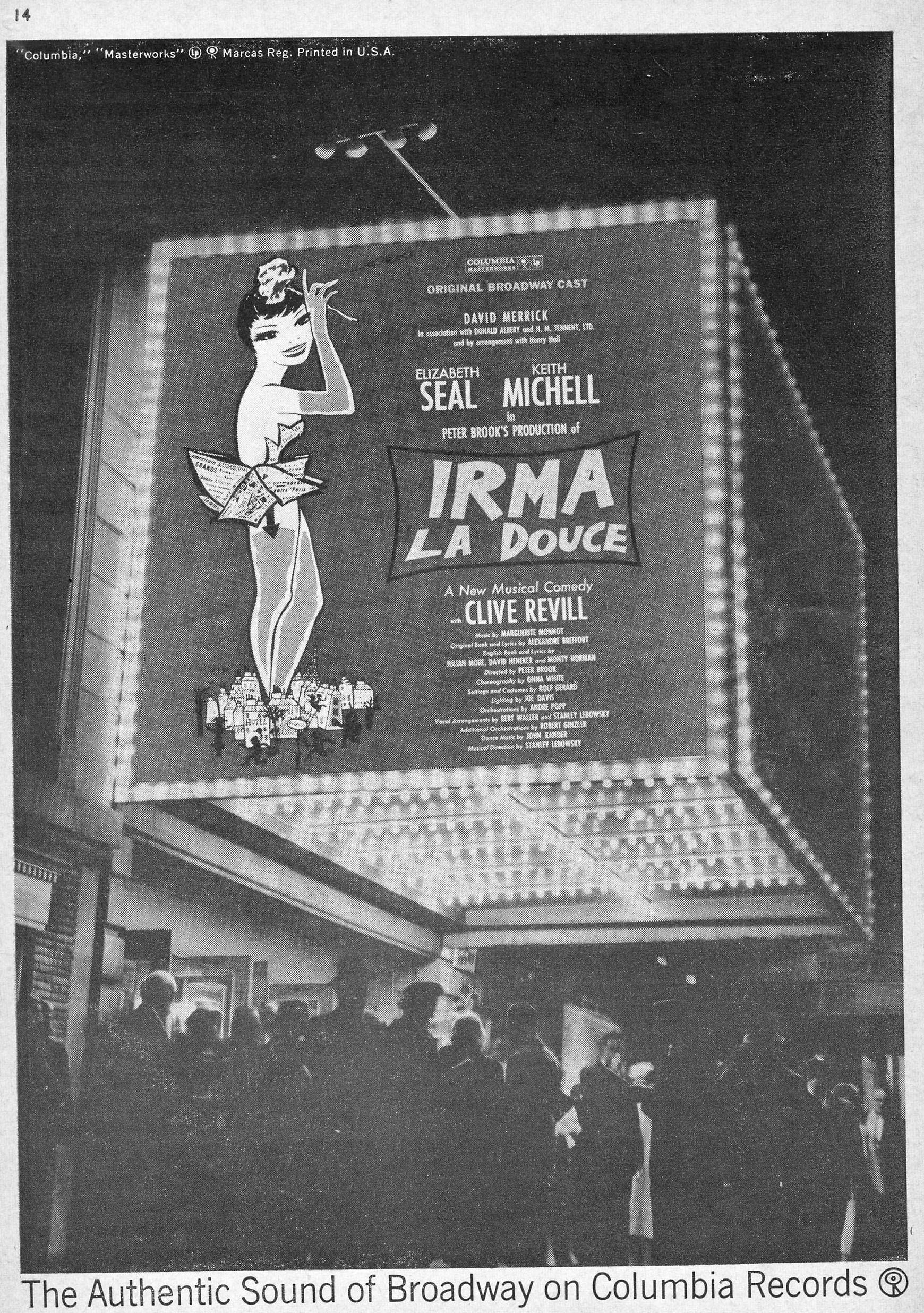 And now a bit about the play. Irma La Douce, based on a a book by Alexandre Breffort, made its 1956 world premiere in Paris, opening in London’s West End in 1958 and finally on Broadway in 1960 at The Plymouth Theatre.
Billed as a new musical comedy it was produced by David Merrick and had its Broadway premier on September 29, 1960, where it ran for 524 performances. The production, starring Elizabeth Seal, winning a Tony in the lead, was directed by Peter Brook. Repeating their roles from the London production were Keith Michell, Elizabeth Seal, and Clive Revill in the leads. Stuart Damon and Fred Gwynne also were featured and actor Eliot Gould was cast in the production as An Usher. The story was made into a non-musical film in 1963 (Irma la Douce), starring Jack Lemmon and Shirley MacLaine.
Life Magazine called the musical “a French fairy tale for wicked grown-ups who want to believe in love.”
““Irma La Douce” is not only French; it is intensely Parisian French. Set in an area tourists seek, but so seldom find, its musical idiom, its moral atmosphere, its plot and its argot are part of Paris not even all Parisians know; a part of Paris where the underworld is known as the “milieu” A tart is a “poule,” a pimp is a “mec” and money is “grisbi.”
Irma La Douce, a successful prostitute, lives in Paris. A poor law student, Nestor le Fripé, falls in love with her and is jealous of her clients. In order to keep her for himself, he assumes the disguise of a rich older man, “Oscar”, and takes many jobs to keep his veneer. Finally no longer able to sustain his exhausting life, he “kills” Oscar, is convicted of murder, and is transported to the Devil’s Island penal colony. He escapes and returns to Paris, and proves that he is innocent. He and Irma reunite and love triumphs.
You may not know these surprising facts about unassuming and multi-talented actor Fred Gwynne, who gained fame both for his distinctive baritone voice and for the role of Herman Munster in the sixties sit-com The Munsters. He attended the Groton School and Harvard University, where he was a cartoonist for the Harvard Lampoon, beginning his theatre career at the Brattle Repertory in Cambridge while in school. Acting in films and plays after graduation, he joined New York ad agency J. Walter Thompson for five years, and wrote copy for Ford Motor Company while appearing in numerous television shows on the side. He left the agency in 1952, the year he made his Broadway debut in “Mrs. McThing,” also appearing opposite the indefatigable Betty White in “Who Was That Lady I Saw You With?” In addition to his acting career, Gwynne sang professionally, painted, wrote and illustrated numerous children’s books and lent his voice talents to commercials and radio shows. Apparently, in addition to lovable Herman Munster, Mr. Gwynne was a certified M-Ad man. Later in his career, he auditioned for TV show Punky Brewster. He withdrew his audition, however, when the auditioner referred to him as Herman Munster and not his professional name. His last film in 1992, “My Cousin Vinny,” was a huge box office hit. He passed away in 1993 and is buried in an unmarked grave.
________________________________________________________________________________________
This week’s tropical cocktail is a true classic, The Daiquiri, which countless suburbanites enjoyed patio and pool-side in the backyard.
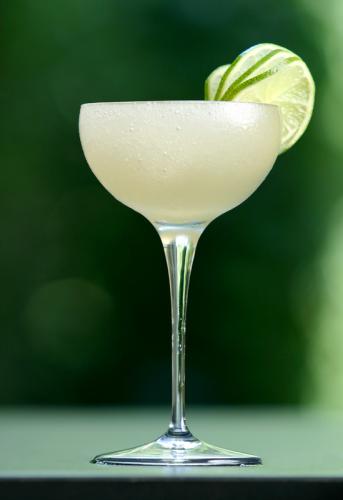
Classic Frozen Daiquiri
The Daiquiri was conceived in 1915, when two engineers from Bethlehem Steel found themselves in the midst of a malaria epidemic in the village of Daiquiri, near Santiago, Cuba . They began putting a little rum in their boiled drinking water as a disinfectant. That brew lacked flavor, so they added a bit of lime, then a touch of sugar. When possible, they added ice made from distilled water and soon found the concoction pleasurable as well as medicinal. A true elixer!
A regular Daiquiri is made by combining one and a half shots (3 oz.) of light rum, a shot of lime juice and a teaspoon of super-fine sugar in an ice-filled shaker. Shake, and strain into a cocktail glass, garnish with a wedge of lime. Frozen Daiquiris are made by combining the ingredients of a Daiquiri with a cup of crushed ice in a blender, with fresh fruit often added for even more flavor. Garnish with a lime wedge and enjoy. Until we meet again!
What is a cocktail? It is style on a stem—American fashion designer, Valentina
Harry Belefonte-I Do Adore Her
http://www.youtube.com/watch?v=EQ8jv_asOxA&feature=related
Round Hill Hotel and Villas, Montego Bay Jamaica
http://www.youtube.com/watch?v=ppJ4VJ2QfFs

 The Stylesmyths: Vintage Fashion Reportage On Broadway